
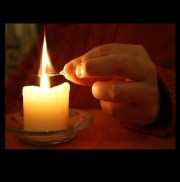
“The foolish ones [virgins] said to the wise [ones], ‘Give us some of your oil, for our lamps are going out.’ But the wise ones replied, ‘No, for there may not be enough for us and you. Go instead to the merchants and buy some for yourselves.’ While they went off to buy it, the bridegroom came and those who were ready went into the wedding feast with him. Then the door was locked. Afterwards the other virgins came and said, ‘Lord, Lord, open the door for us!’ But he said in reply, ‘Amen, I say to you, I do not know you.’ Therefore, stay awake, for you know neither the day nor the hour.” Matthew 25.

A Burning Candle
“I haven’t seen you for awhile, what have you been up to,” asks a good friend. Listen to her responses as well as those of others. “Well, ‘this and that.’” Wow. Another great conversation exchanged on this glorious and adventurous and mysterious and sometimes baffling journey we call life.
Are “this and that” equal in amount or is there sometimes more of life’s that’s than the this’s!? Or does her this’s beat out her that’s? It now becomes my job and responsibility to work out and to figure out what she’s trying to tell me by my asking her a simple question that is asked to all of us every single day? The work I need to do that should be done by others.
The response I love is, “the usual,” as though anything unusual would never cross this person’s path. Anything unusual would surely throw this person a curveball, never to be caught. “Same old, same old” is not only grammatically redundant but truly summarizes this individual’s human existence; second only to, “been there, done that.” Hearing that kinda takes your breath away, doesn’t it? The weirdest response to a question about your wellbeing is, “Oh, you know.” This is a fill-in-the-blank response. “No, I don’t know.” If I knew the response, I wouldn’t have asked the question!
“Miscellaneous” is a cool word, but it only suggests as much as “bits and pieces” does. “Hodgepodge” is the individuals with a messy desk that reflects the inner workings of their brains. You can add “mishmash” to this growing list that includes “mixed bag” and a writer’s laziness in typing, “etcetera” at the end of a sentence, leaving it to our imaginations to complete the writer’s thought. In your mundane reality of living, use the word “paraphernalia” to justify your humanity and then ask your friend to spell it.
Is the routine of our predictable days so habitual that nightly television satisfies our lack of daily drama? What pushes the bed covers away in our early mornings, especially during winter months?
Is it the earned buck just for showing up or is it a growing and evolving process in your life that amounts to passion, commitment, and resolve. Is there enough passion in your life to make you smile or cry at either its success or failure? The biblical lamp oil leads us to passionate occupations and commitments. And then, ironically, that same oil keeps that flame alive and even increases its fiery blaze throughout our lives. It is the flame of life and the flame of our faith.
Flames like seeking out new insights to old problems, uncovering a new side of an old friend (“I didn’t know he had it in him!”), an important book read for the third time, the clouds formation and reformations segue into dusk, the stillness of a November evening like the one I’m witnessing writing this, the memories that earned the adjective “cherished” and those labeled “forgiven but not forgotten,” a simple, new goal to be completed the same day, a touching phrase or impressive thought told by a friend that you want to remember (but not the “this or that” friend).
Mine’s a silly list of sundry items – or is it? How often we say to ourselves, “Tomorrow, something will excite me again” while all the time, the this’s and that’s of today escapes us when today is the one and only one we genuinely hold and possess, like a burning lamp.
“Tomorrow” is sadly but safely housed in the attic of those “Same old, same old” people. Passions and commitments are the beauty and force that makes this life worthy of the value of each of our breaths.
Books by Fr. Joe Jagodensky, SDS. All available on Amazon.com
“Soulful Muse,”
inspirational reflections on the Catholic Church and U.S. culture
“Living Faith’s Mysteries,”
inspirational reflections on the Christian seasons
of Advent/Christmas & Lent/Easter – a great seasonal gift
“Spiritual Wonderings and Wanderings,”
inspirational reflections on the Catholic Church and U.S. culture
“Letters From My Cats,”
a collection of letters written by my cats over twenty years
“Bowling Through Life’s Stages with a Christian perspective,”
Bowling as a metaphor for religion and growing up
 It’s tough being a priest. Housekeepers and cooks, being driven everywhere, paid for meals at expensive restaurants, weekly gifts of checks and cash. Everyone calling you what Jesus expressly told us not to call you, “Father.”
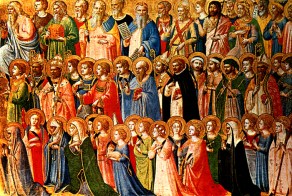
 We pray for them as though their destiny can be changed. We talk about them as the “poor souls in purgatory” when purgatory is the gateway to heaven. (They ain’t “poor,” by any means folks.) Years ago, on this day in grade school we could say an “Our Father, Hail Mary and Glory Be” inside the church. We then needed to leave the church, and a soul would ascend to Heaven. We could repeat this as often as our little feet or minds could endure this repetitious ritual. It sounds silly today, but back then, it was pretty important work. (Taking the place of God’s judgment is a big job; too bad we feel the urge to take His place!)
 Your parent tells you, “Stop pretending!” “Do your homework.” “Take out the garbage.”
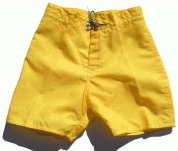 My mother would tell me that “I’m getting too big for my britches,” when I thought too much of myself. I’ve never owned a pair of britches. Jesus questions us by saying, “If you cannot love yourself then how can you extend love to another?” The Church would surely tell us, “Love yourself? Are you kidding?” Perhaps, “‘Kinda like’ yourself would be okay but never love yourself.” Or the Church may say, “Try ‘sort of’ like yourself, try that on for size but never, ever think of loving yourself.” That’s the Church talking to us, not me. If I took a poll here in church of how many of you, “Love yourselves,” 80% of you would say, “No” in deference to the teachings of the Catholic Church. But that’s not what Jesus is asking of us.
 All right, I have something important to tell you. It’s not easy to talk about it but my therapist said that, “Talking about it will make a difference in my life.”
 Someone says, “Life is so complicated,” which it is not. Another declares, “Life is overwhelming,” turn off your cell phone and TV and see what happens. A third person sighs, “Life escapes me,” it probably has because you’ve haven’t embraced it. (Still living in your parent’s house at thirty-years-old is your first clue.)
 “When did Jesus know he was God?” asked the twelve-year-old. I thought to myself, “A developmental question” from someone developing herself. I quickly needed to answer because, as you know, priests have all the answers on the cuffs of their shirts without thinking about it. (If it’s French cuffs then you aspire higher than the mere priesthood.)
 Eckhart von Hochheim O.P. (commonly called “Meister Eckhart”), 1260 – 1328
 Rev. Joe Jagodensky, SDS.
 Soulful Muse